"So Many Books...So Little Time"
Some of the Library's newly-acquired books that have been highlighted on Colonie's Cable Channel 17 show called "So Many Books..So Little Time."
Wednesday, February 1, 2012
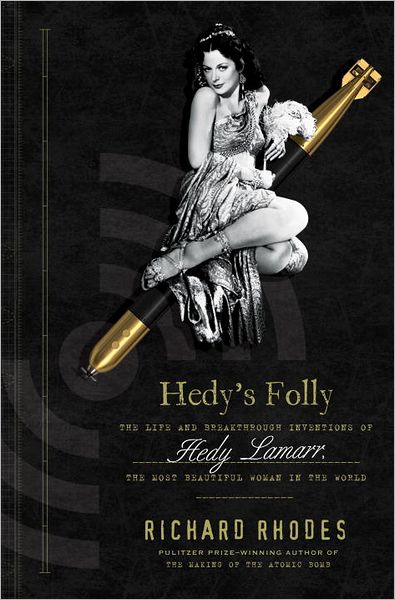
Hedy's Folly: The Life and Breakthrough Inventions of Hedy Lamarr, the Most Beautiful Woman in the World
The author of The Twilight of the Bomb (2010) returns with the surprising story of a pivotal invention produced during World War II by a pair of most unlikely inventors--an avant-garde composer and the world's most glamorous movie star. Pulitzer and NBA winner Rhodes offers the stories of his two principals in alternating segments, sometimes chapter-length. The diminutive pianist/composer George Antheil--who worked with Stravinsky, Ezra Pound, Balanchine, DeMille and other notables--was also a prolific writer and inventor. And Lamarr (born Hedwig Kiesler), smitten by the theater in her native Austria, married a wealthy man charmed by Nazis; she later fled for Hollywood, where she quickly established herself as a major star in such films as Algiers and Ziegfeld Girl. She crossed trails with Antheil, who'd also moved west. Rhodes shows us that Lamarr (a new surname name suggested by the wife of Louis B. Mayer) was extremely bright (though poorly educated), a woman who had an area in her house devoted to inventing. And Antheil--who'd once composed a piece requiring 16 synchronized player pianos--had inventing interests that dovetailed with Lamarr's. They worked together to invent a way to radio-guide torpedoes and to use a technique called frequency-hopping to insure that the enemy could not jam their signals. Lamarr and Antheil secured a patent, but the U.S. Navy did not adopt the device, which, as Rhodes shows, would form the foundations of today's Bluetooth, Wi-Fi and other wireless technologies. Antheil died before earning any recognition for this achievement, but Lamarr, late in her life, did receive awards. The author quotes liberally--perhaps overly so--from the memoirs of his principals. A faded blossom of a story, artfully restored to bright bloom. (Check Catalog)
Lights of Mankind: The Earth at Night as Seen from Space
"Celebrating--and understanding--our Earth from space""" "The Lights of Mankind" is the story of how we've populated this planet as told through inspiring, panoramic photographs of Earth at night. It showcases unexpected and breathtaking photos made possible by the latest light-sensitive cameras and the newly installed Cupola on the International Space Station--pictures that have already awed hundreds of thousands Space Station fans. The images, of course, beg explanation. Why did Man settle here and not there? How is this glittering planet powered? The narrative explores the expected and unexpected, telling a story of agriculture, geography, wars, disease, food supply, water supply, politics, politics and power supply. The uncertain sprawl of southern California. The Nile River as it snakes towards the Mediterranean. The grid-like pattern of lights that write the history of the American Midwest. This is the "unintended artwork of human habitation," as author Keeney writes, artwork we now see first-hand. Includes first-person perspectives on Earth at night contributed by the astronauts themselves--Don Pettit, Douglas Wheelock, Mario Runco, Jr., Clayton "Clay" Anderson, and Sandra Magnus. (Check Catalog)
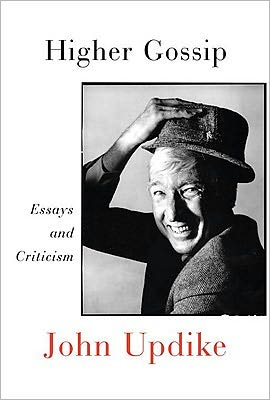
Higher Gossip: Essays and Criticism
A collection both intimate and generous of the eloquent, insightful, beautifully written prose works that John Updike was compiling when he died in January 2009.
This collection of miscellaneous prose opens with a self-portrait of the writer in winter, a Prospero who, though he fears his most dazzling performances are behind him, reveals himself in every sentence to be in deep conversation with the sources of his magic. It concludes with a moving meditation on a modern world robbed of imagination--a world without religion, without art--and on the difficulties of faith in a disbelieving age. In between are previously uncollected stories and poems, a pageant of scenes from seventeenth-century Massachusetts, five late "golf dreams," and several of Updike's commentaries on his own work. At the heart of the book are his matchless reviews--of John Cheever, Ann Patchett, Toni Morrison, William Maxwell, John le Carre, and essays on Aimee Semple McPherson, Max Factor, and Albert Einstein, among others. Also included are two decades of art criticism--on Chardin, El Greco, Blake, Turner, Van Gogh, Max Ernest, and more.
Updike's criticism is gossip of the highest order, delivered in an intimate and generous voice. (Check Catalog)
This collection of miscellaneous prose opens with a self-portrait of the writer in winter, a Prospero who, though he fears his most dazzling performances are behind him, reveals himself in every sentence to be in deep conversation with the sources of his magic. It concludes with a moving meditation on a modern world robbed of imagination--a world without religion, without art--and on the difficulties of faith in a disbelieving age. In between are previously uncollected stories and poems, a pageant of scenes from seventeenth-century Massachusetts, five late "golf dreams," and several of Updike's commentaries on his own work. At the heart of the book are his matchless reviews--of John Cheever, Ann Patchett, Toni Morrison, William Maxwell, John le Carre, and essays on Aimee Semple McPherson, Max Factor, and Albert Einstein, among others. Also included are two decades of art criticism--on Chardin, El Greco, Blake, Turner, Van Gogh, Max Ernest, and more.
Updike's criticism is gossip of the highest order, delivered in an intimate and generous voice. (Check Catalog)
Hopper
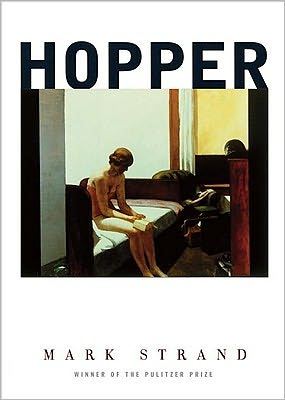
Now in rich color, thirty of American painter Edward Hopper's masterpieces with critiques from acclaimed poet Mark Strand. Strand deftly illuminates the work of the frequently misunderstood American painter, whose enigmatic paintings--of gas stations, storefronts, cafeterias, and hotel rooms--number among the most powerful of our time.
In brief but wonderfully compelling comments accompanying each painting, the elegant expressiveness of Strand's language is put to the service of Hopper's visual world. The result is a singularly illuminating presentation of the work of one of America's best-known artists. Strand shows us how the formal elements of the paintings--geometrical shapes pointing beyond the canvas, light from unseen sources--locate the viewer, as he says, "in a virtual space where the influence and availability of feeling predominate."
An unforgettable combination of prose and painting in their highest forms, this book is a must for poetry and art lovers alike. (Check Catalog)
In brief but wonderfully compelling comments accompanying each painting, the elegant expressiveness of Strand's language is put to the service of Hopper's visual world. The result is a singularly illuminating presentation of the work of one of America's best-known artists. Strand shows us how the formal elements of the paintings--geometrical shapes pointing beyond the canvas, light from unseen sources--locate the viewer, as he says, "in a virtual space where the influence and availability of feeling predominate."
An unforgettable combination of prose and painting in their highest forms, this book is a must for poetry and art lovers alike. (Check Catalog)
Three and Out: Rich Rodriguez and the Michigan Wolverines in the Crucible of College Football Contributor(s): Bacon, John U (Author)
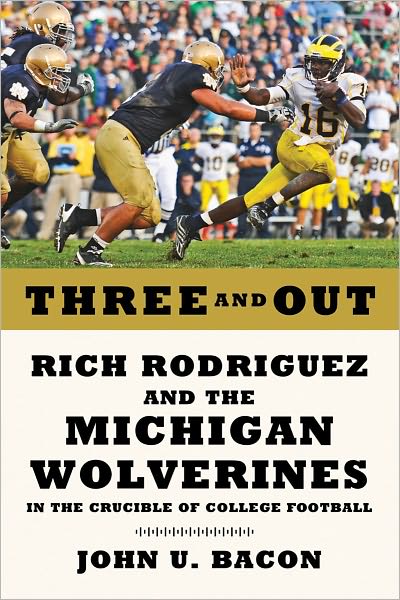
"Three and Out" tells the story of how college football's most influential coach took over the nation's most successful program, only to produce three of the worst seasons in the histories of both Rich Rodriguez and the University of Michigan. Shortly after his controversial move from West Virginia, where he had just taken his alma mater to the #1 ranking for the first time in school history, Coach Rich Rodriguez granted author and journalist John U. Bacon unrestricted access to Michigan's program. Bacon saw it all, from the meals and the meetings, to the practices and the games, to the sidelines and the locker rooms. Nothing and no one was off limits. John U. Bacon's "Three and Out" is the definitive account of a football marriage seemingly made in heaven that broke up after just three years, and lifts the lid on the best and the worst of college football. (Check Catalog)
Good Housekeeping Drop 5 lbs: The Small Changes, Big Results Diet

Sometimes it's the simple choices-like switching diet soda for regular; selecting a less-caloric sandwich at the fast food joint; stopping at just one dip into the candy bowl; filling up on salad rather than bread before your main course; or taking the kids for a bike ride instead of hanging out in front of the TV-that make the pounds melt away almost effortlessly. Whether you're a junk food junkie, an emotional eater, or even a mindless muncher, "Good Housekeeping Drop 5 Pounds" offers hundreds of ideas for small and very doable changes in your diet that can add up to significant weight loss.
The Diet Decoder quiz right at the start helps you pinpoint your particular eating patterns and food pitfalls, priming you for a transformation. Then, follow the icons to identify customized strategies that target your behavior. Plus you'll learn about diet destroyers like the hidden calories in "friendly" foods; simple substitutes that make both home-cooked and restaurant-bought foods less fattening; how to avoid holiday weight gain; and practical ways to incorporate exercise into your routine. Easy-to-follow charts identify "Diet Madness" meals and give you "Diet Makeover" alternatives, plus "Make This Swap" suggestions.
Every chapter opens with "Drop 5 Top 5" strategies to ditch the pounds at home, at work, and at play.
HERE'S HOW TO DROP 5 POUNDS IN JUST TWO WEEKS!
o Start with a self-quiz to diagnose your diet pitfalls
o Use our Diet Makeovers to end Diet Disasters
o Steal our Special Diet Tricks for Meal Skippers, Nonstop Nibblers, Liquid Calorie Lovers, Emotional Eaters, and Junk Food Junkies
o Mix and match our Drop 5 advice to change your diet according to your tastes and habits
o Choose from dozens of fat-blasting recipes to drop 5 pounds (Check Catalog)
The Diet Decoder quiz right at the start helps you pinpoint your particular eating patterns and food pitfalls, priming you for a transformation. Then, follow the icons to identify customized strategies that target your behavior. Plus you'll learn about diet destroyers like the hidden calories in "friendly" foods; simple substitutes that make both home-cooked and restaurant-bought foods less fattening; how to avoid holiday weight gain; and practical ways to incorporate exercise into your routine. Easy-to-follow charts identify "Diet Madness" meals and give you "Diet Makeover" alternatives, plus "Make This Swap" suggestions.
Every chapter opens with "Drop 5 Top 5" strategies to ditch the pounds at home, at work, and at play.
HERE'S HOW TO DROP 5 POUNDS IN JUST TWO WEEKS!
o Start with a self-quiz to diagnose your diet pitfalls
o Use our Diet Makeovers to end Diet Disasters
o Steal our Special Diet Tricks for Meal Skippers, Nonstop Nibblers, Liquid Calorie Lovers, Emotional Eaters, and Junk Food Junkies
o Mix and match our Drop 5 advice to change your diet according to your tastes and habits
o Choose from dozens of fat-blasting recipes to drop 5 pounds (Check Catalog)
On Conan Doyle: Or, the Whole Art of Storytelling
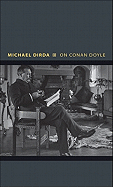
Pulitzer Prize–winning Washington Post book critic Dirda (Classics for Pleasure, 2007, etc.) provides a personal voyage around the creator of Sherlock Holmes and a prodigious variety of lesser-known heroes, worlds and volumes.
Most readers know that Arthur Conan Doyle, who never signed his books "Sir Arthur," thought so little of his most celebrated hero that he tried to kill him off. But most studies of Doyle place Holmes at the center of Doyle's universe. It's fair to say that Dirda's does as well, but the author tries hard to supplement his emphasis on Holmes with due attention to the adventures of Doyle's own favorite character, Professor Challenger, his horror and fantasy tales, his broadsides and his letters. Rooting his discussion in his memories of his own introduction to Doyle's writings, Dirda recalls his investiture in the Baker Street Irregulars and reprints an abridged version of his essay "A Case for Langdale Pike," his own addition to the delightful faux scholarship of Sherlockiana. Dirda is at his best in his sensitive appreciation of Doyle's style, direct, fluent, and surprisingly flexible as he moves from genre to genre, and in his account of manly civic inspiration as the value Doyle aimed above all to inculcate in his writing (a value in which he found the Holmes stories lamentably deficient). But many of Dirda's own adventures among Doyle's works, beguiling as they are, could well have been condensed to make room for a more detailed review of the three kinds of writing Doyle considered his most significant: his historical romances, his multivolume history of the Boer War and especially his writings on spiritualism, which Dirda short-changes because he feels so uncomfortable with them.
Despite a few shortcomings, an endearing, well-balanced introduction to a writer the Strand Magazine called "the greatest natural storyteller of his age." (Check Catalog)
Most readers know that Arthur Conan Doyle, who never signed his books "Sir Arthur," thought so little of his most celebrated hero that he tried to kill him off. But most studies of Doyle place Holmes at the center of Doyle's universe. It's fair to say that Dirda's does as well, but the author tries hard to supplement his emphasis on Holmes with due attention to the adventures of Doyle's own favorite character, Professor Challenger, his horror and fantasy tales, his broadsides and his letters. Rooting his discussion in his memories of his own introduction to Doyle's writings, Dirda recalls his investiture in the Baker Street Irregulars and reprints an abridged version of his essay "A Case for Langdale Pike," his own addition to the delightful faux scholarship of Sherlockiana. Dirda is at his best in his sensitive appreciation of Doyle's style, direct, fluent, and surprisingly flexible as he moves from genre to genre, and in his account of manly civic inspiration as the value Doyle aimed above all to inculcate in his writing (a value in which he found the Holmes stories lamentably deficient). But many of Dirda's own adventures among Doyle's works, beguiling as they are, could well have been condensed to make room for a more detailed review of the three kinds of writing Doyle considered his most significant: his historical romances, his multivolume history of the Boer War and especially his writings on spiritualism, which Dirda short-changes because he feels so uncomfortable with them.
Despite a few shortcomings, an endearing, well-balanced introduction to a writer the Strand Magazine called "the greatest natural storyteller of his age." (Check Catalog)
Subscribe to:
Posts (Atom)