"So Many Books...So Little Time"

Some of the Library's newly-acquired books that have been highlighted on Colonie's Cable Channel 17 show called "So Many Books..So Little Time."

Thursday, February 20, 2014

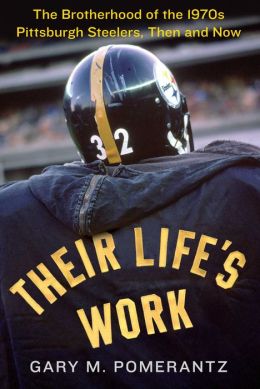
Their Life's Work: The Brotherhood of the 1970s Pittsburgh Steelers, Then and Now

by Gary M Pomerantz    (Find this book)
ONE TEAM. FOUR SUPER BOWL CHAMPIONSHIPS. TWELVE HALL OF FAMERS. TWO HUNDRED INTERVIEWS.
They were the best to ever play the game: the Pittsburgh Steelers of the 1970s. Three decades later their names echo in popular memory--Mean Joe, Bradshaw, Webster, Lambert, Ham, Blount, Franco, Swann, and Stallworth. They define not only the brother-hood and camaraderie of football, but what Americans love about their most popular sport: its artistry and its brutality. From the team's origins in a horseplayer's winnings to the young armored gods who immaculately beat the Raiders in 1972 to the grandfathers with hobbles in their gait, "Their Life's Work" tells the full, intimate story of the Steeler dynasty. But this book does much more than that: it tells football's story. What the game gives, what it takes, and why, to a man, every Steeler, full well knowing the costs, unhesitatingly states, "I'd do it again."  -- Publisher Marketing

Tuesday, February 18, 2014

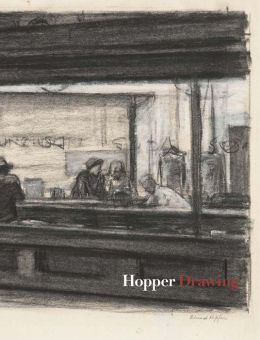
Hopper Drawing

by Carter E Foster    (Find this book)
Edward Hopper (1882-1967) is recognized as one of the most well-known American artists of the 20th century. His distinctive style, combining subtle observations of the world with his imagination, has not only influenced other artists but also photographers, filmmakers, and popular culture. Although Hopper is primarily known for his oil paintings, including such iconic works as "Nighthawks "(1942) and "Early Sunday Morning" (1930), this important publication is the first comprehensive exploration of his drawings and working methods. In 1967, Hopper's widow, Josephine Nivison Hopper, bequeathed her husband's artistic estate to the Whitney Museum of American Art, including a fascinating collection of more than 2,500 drawings spanning his entire career. This group of works has never been the subject of in-depth study and many have never been reproduced before. Hopper kept these drawings for personal reference as he revisited various themes throughout his career. Carter E. Foster examines how Hopper used his drawings to develop his paintings, arguing that the artist's work can only be fully understood after careful study of these preparatory sketches. Foster also argues that Hopper was, in many ways, a traditional draftsman who methodically developed schematic ideas into detailed studies to refine content. However, the steps toward this refinement are unique to Hopper and reveal how he turned the mundane into poetic images with universal appeal.  -- Publisher Marketing

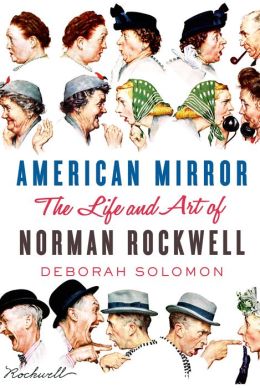
American Mirror: The Life and Art of Norman Rockwell

by Deborah Solomon     (Find this book)
The long-awaited biography of the defining illustrator of the twentieth century by a celebrated art critic.
Norman Rockwell, as much as Walt Disney or Ronald Reagan, provided America with a mirror of its dreams and aspirations. As the star illustrator for "The Saturday Evening Post "for nearly half a century, Rockwell portrayed a fantasy of civic togetherness, of American decency and good cheer. Or, as Deborah Solomon writes in her authoritative new biography, he painted "a history of the American people that had never happened."
Who was Norman Rockwell? Behind the folksy, pipe-smoking facade lay a surprisingly complex figure--a lonely man all too conscious of his inadequacies. Solomon describes him as an obsessive personality who wore his shoes too small, washed his paintings with Ivory Soap, and relied on the redemptive power of storytelling to stave off depression. He wound up in treatment with Erik Erikson, the influential psychotherapist. "American Mirror" draws on unpublished papers to explore the relationship between Rockwell's anguished creativity and his genius for reflecting American innocence. "The thrill of his work," writes Solomon, "is that he was able to use the commercial form of magazine illustration to thrash out his private obsessions."
In "American Mirror," Solomon, a biographer and art critic, trains her perceptive eye on both the art and the man. She also brilliantly chronicles the visual history of American journalism and the battle pitting photography against illustration.  -- Publisher Marketing

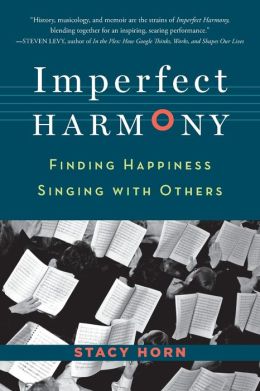
Imperfect Harmony: Finding Happiness Singing with Others

by Stacy Horn    (Find this book)
For Stacy Horn, regardless of what is going on in the world or her life, singing in an amateur choir the Choral Society of Grace Church in New York never fails to take her to a place where hope reigns and everything good is possible. She s not particularly religious, and her voice is not exceptional (so she says), but like the 32.5 million other chorus members throughout this country, singing makes her happy. Horn brings us along as she sings some of the greatest music humanity has ever produced, delves into the dramatic stories of conductors and composers, unearths the fascinating history of group singing, and explores remarkable discoveries from the new science of singing, including all the unexpected health benefits. "Imperfect Harmony" is the story of one woman who has found joy and strength in the weekly ritual of singing and in the irresistible power of song.  --  Publisher Marketing

Fifty Railroads That Changed the Course of History

by Bill Laws    (Find this book)
Praise for previous titles in the series:
Fifty Minerals That Changed the Course of History
"Interesting, affordable and readable.... Offers the reader an opportunity to delve further into each mineral's historical significance in an accessible way."
-- Booklist
Fifty Animals That Changed the Course of History
"An original approach that links the biological sciences to the social sciences... students and general readers will find many interesting stories within these pages."
-- American Reference Books Annual
The new title in the series, "Fifty Railroads that Changed the Course of History," is a handsome, illustrated survey of the most important historical and contemporary railway lines around the world. Filled with unusual and unexpected stories and facts, it will captivate a wide audience, from the curious browser to researching students.
The book organizes the railroads chronologically, considering each according to its greatest impact on Social, Commercial, Political, Engineering, and Military history. Maps plus more than 200 elegant drawings, photographs and paintings as well as dozens of sidebars highlight the concise, engaging text.
The fifty railroads span history, from the first in public passenger travel (Wales, 1807) to Japan's speed-record breaking "Bullet." Exotic locales reflect the map of colonialism (Guyana to transport sugar, India to carry cotton and arms). Railroads moved troops (the Crimea, the American Civil War, the Boer War) and united vast lands (Canadian Pacific Railway, Trans-Siberian). They transported horror (Auschwitz Ker), saved the Railway Children, and went underground to cross the English Channel.
"Fifty Railroads that Changed the Course of History" features rail barons, politicians, disasters, crime, weather, geology, great artists, fraudsters and animals, a dynamic cast of characters and a mind-spinning whirlwind of fact, trivia and conversation starters. -- Publisher Marketing

Friday, February 14, 2014

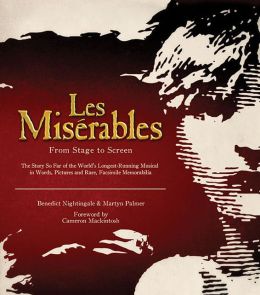
Les Miserables: From Stage to Screen

by Benedict Nightingale    (Find this book)
It has been 150 years since Victor Hugo's novel Les Miserables was first published. However, for the last 25 or so, the poignant saga of Jean Valjean, a villain to some but a savior to others, set in France during the early years of the 19th century, has become one of the world's most popular musicals and has become one of the must-see movies of 2013. In Les Miserables: From Stage to Screen, the reader can find out how the musical came to life the trials and tribulations of turning it from the initial concept into a thrilling musical extravaganza and how the new film version starring Hugh Jackman and Russell Crowe and directed by the Oscar-winning Tom Hooper ( The King's Speech ) has emerged from the show that has been seen by over 60 million people worldwide. To bring this fascinating story to life, the book also contains at least 20 facsimiles that highlight key moments in the creation of Les Miserables, both on stage and on the screen, including: * Original costume sketches * Annotated scripts * Original music scores and librettos * Film screenplay extracts and anniversary mementos  --  Publisher Marketing

Tuesday, February 11, 2014

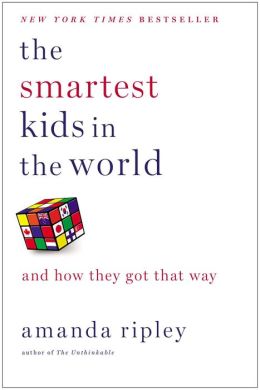
The Smartest Kids in the World: And How They Got That Way

by Amanda Ripley    (Find this book)
How Do Other Countries Create "Smarter" Kids?
In a handful of nations, virtually all children are learning to make complex arguments and solve problems they've never seen before. They are learning to think, in other words, and to thrive in the modern economy.
What is it like to be a child in the world's new education superpowers?
In a global quest to find answers for our own children, author and Time magazine journalist Amanda Ripley follows three Americans embedded in these countries for one year. Kim, fifteen, raises $10,000 so she can move from Oklahoma to Finland; Eric, eighteen, exchanges a high-achieving Minnesota suburb for a booming city in South Korea; and Tom, seventeen, leaves a historic Pennsylvania village for Poland.
Through these young informants, Ripley meets battle-scarred reformers, sleep-deprived zombie students, and a teacher who earns $4 million a year. Their stories, along with groundbreaking research into learning in other cultures, reveal a pattern of startling transformation: none of these countries had many "smart" kids a few decades ago. Things had changed. Teaching had become more rigorous; parents had focused on things that mattered; and children had bought into the promise of education.
A journalistic tour de force, "The Smartest Kids in the World" is a book about building resilience in a new world--as told by the young Americans who have the most at stake. -- Publisher Marketing