"So Many Books...So Little Time"

Some of the Library's newly-acquired books that have been highlighted on Colonie's Cable Channel 17 show called "So Many Books..So Little Time."

Tuesday, January 14, 2014

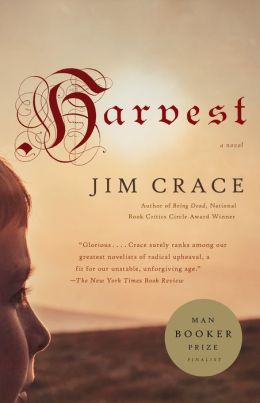
Harvest

by Jim Crace    (Find this book)
On the morning after harvest, the inhabitants of a remote English village awaken looking forward to a hard-earned day of rest and feasting at their landowner's table. But the sky is marred by two conspicuous columns of smoke, replacing pleasurable anticipation with alarm and suspicion.
One smoke column is the result of an overnight fire that has damaged the master's outbuildings. The second column rises from the wooded edge of the village, sent up by newcomers to announce their presence. In the minds of the wary villagers a mere coincidence of events appears to be unlikely, with violent confrontation looming as the unavoidable outcome. Meanwhile, another newcomer has recently been spotted taking careful notes and making drawings of the land. It is his presence more than any other that will threaten the village's entire way of life.
In effortless and tender prose, Jim Crace details the unraveling of a pastoral idyll in the wake of economic progress. His tale is timeless and unsettling, framed by a beautifully evoked world that will linger in your memory long after you finish reading.  -- Publisher Marketing

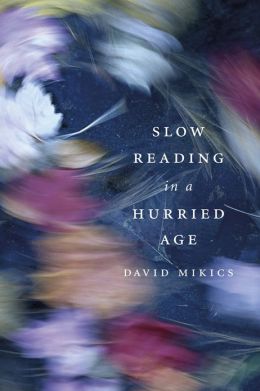
Slow Reading in a Hurried Age

by David Mikics    (Find this book)
Wrapped in the glow of the computer or phone screen, we cruise websites; we skim and skip. We glance for a brief moment at whatever catches our eye and then move on. "Slow Reading in a Hurried Age" reminds us of another mode of reading--the kind that requires our full attention and that has as its goal not the mere gathering of information but the deeper understanding that only good books can offer.
""
"Slow Reading in a Hurried Age" is a practical guide for anyone who yearns for a more meaningful and satisfying reading experience, and who wants to sharpen reading skills and improve concentration. David Mikics, a noted literary scholar, demonstrates exactly how the tried-and-true methods of slow reading can provide a more immersive, fulfilling experience. He begins with fourteen preliminary rules for slow reading and shows us how to apply them. The rules are followed by excursions into key genres, including short stories, novels, poems, plays, and essays.
Reading, Mikics says, should not be drudgery, and not mere escape either, but a way to live life at a higher pitch. A good book is a pathway to finding ourselves, by getting lost in the words and works of others.  -- Publisher Marketing

Friday, January 10, 2014

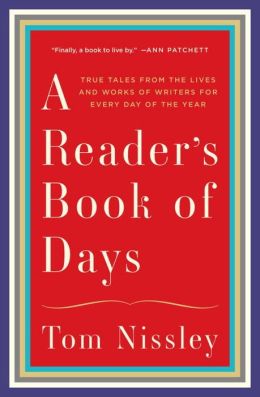
A Reader's Book of Days: True Tales from the Lives and Works of Writers for Every Day of the Year

by Tom Nissley    (Find this book)
At once a love letter to literature and a charming guide to the books most worth reading, A Reader's Book of Days features bite-size accounts of events in the lives of great authors for every day of the year. Here is Marcel Proust starting In Search of Lost Time and Virginia Woolf scribbling in the margin of her own writing, "Is it nonsense, or is it brilliance?" Fictional events that take place within beloved books are also included: the birth of Harry Potter's enemy Draco Malfoy, the blood-soaked prom in Stephen King's Carrie.
A Reader's Book of Days is filled with memorable and surprising tales from the lives and works of Martin Amis, Jane Austen, James Baldwin, Roberto Bolano, the Bronte sisters, Junot Diaz, Philip K. Dick, Charles Dickens, Joan Didion, F. Scott Fitzgerald, John Keats, Hilary Mantel, Haruki Murakami, Flannery O'Connor, Orhan Pamuk, George Plimpton, Marilynne Robinson, W. G. Sebald, Dr. Seuss, Zadie Smith, Susan Sontag, Hunter S. Thompson, Leo Tolstoy, David Foster Wallace, and many more. The book also notes the days on which famous authors were born and died; it includes lists of recommended reading for every month of the year as well as snippets from book reviews as they appeared across literary history; and throughout there are wry illustrations by acclaimed artist Joanna Neborsky.
Brimming with nearly 2,000 stories, A Reader's Book of Days will have readers of every stripe reaching for their favorite books and discovering new ones. -- Publisher Marketing

Stella Adler on America's master playwrights : Eugene O'Neill, Thornton Wilder, Clifford Odets, William Saroyan, Tennessee Williams, William Inge, Arthur Miller, Edward Albee

by Stella Adler   (Find this book)
Brilliant lectures on the American masters from the late, legendary acting teacher. The indomitable Stella Adler (1901-1992), who tutored Marlon Brando, displays both her omnivorous intellect and decades of experience in this generous second volume of acting-class lectures (following Stella Adler on Ibsen, Strindberg and Chekhov, 1999) edited by celebrity biographer Paris (Garbo, 2002, etc.). Here, the teacher covers Eugene O'Neill, Thornton Wilder, Clifford Odets, William Saroyan, Tennessee Williams, William Inge, Arthur Miller and Edward Albee. Adler knew the play, she knew the writer, and her message to her actors was direct: You must understand the play and the playwright at both the macro and micro level. You can't do O'Neill if you don't know about his tormented Irish-Catholic background; you can't perform A Streetcar Named Desire or Death of a Salesman if you don't know about postwar alienation. "If you don't use the play's world, you are not an actor, because the play is taken from that world, not yours, and you have to go there to find it." Also, you must know the character's inner and outer life: "Does he have an accent? How does he dress, how does he wear his hair? ...What are the circumstances he lives in?" In Beyond the Horizon, Robert is weak, but don't play him weak; he thinks he is strong. In Mourning Becomes Electra, play Christine like a queen; "use your epic voice, not a little intimate voice." In The Glass Menagerie, Laura wears a leg brace; when she sits on the floor with her gentleman caller, she's in pain. Read between the lines; follow what's said and what isn't. Adler has another, subtler message for her actors: Stay true to your art. An exciting, inspiring and essential book for anyone interested in American theater. COPYRIGHT(2012) Kirkus Reviews, ALL RIGHTS RESERVED.


The Smithsonian's History of America in 101 Objects

by Richard Kurin    (Find this book)
The Smithsonian Institution is America's largest, most important, and most beloved repository for the objects that define our common heritage. Now Under Secretary for Art, History, and Culture Richard Kurin, aided by a team of top Smithsonian curators and scholars, has assembled a literary exhibition of 101 objects from across the Smithsonian's museums that together offer a marvelous new perspective on the history of the United States.
Ranging from the earliest years of the pre-Columbian continent to the digital age, and from the American Revolution to Vietnam, each entry pairs the fascinating history surrounding each object with the story of its creation or discovery and the place it has come to occupy in our national memory. Kurin sheds remarkable new light on objects we think we know well, from Lincoln's hat to Dorothy's ruby slippers and Julia Child's kitchen, including the often astonishing tales of how each made its way into the collections of the Smithsonian. Other objects will be eye-opening new discoveries for many, but no less evocative of the most poignant and important moments of the American experience. Some objects, such as Harriet Tubman's hymnal, Sitting Bull's ledger, Cesar Chavez's union jacket, and the "Enola Gay "bomber, tell difficult stories from the nation's history, and inspire controversies when exhibited at the Smithsonian. Others, from George Washington's sword to the space shuttle "Discovery," celebrate the richness and vitality of the American spirit. In Kurin's hands, each object comes to vivid life, providing a tactile connection to American history.
Beautifully designed and illustrated with color photographs throughout, "The Smithsonian's History of America in 101 Objects "is a rich and fascinating journey through America's collective memory, and a beautiful object in its own right. -- Publisher Marketing

Thursday, January 9, 2014

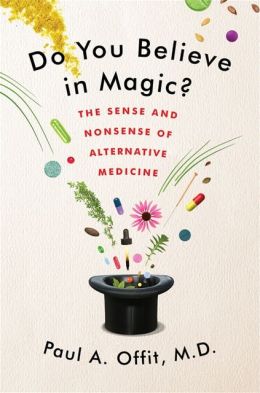
Do You Believe in Magic?: The Sense and Nonsense of Alternative Medicine

by Paul A. Offit    (Find this book)
Medical expert and health advocate Dr. Paul A. Offit offers an impassioned and meticulously researched expose of the alternative medicine industry.
A half century ago, acupuncture, homeopathy, naturopathy, Chinese herbs, Christian exorcisms, dietary supplements, chiropractic manipulations, and ayurvedic remedies were considered on the fringe of medicine. Now these practices--known variably as alternative, complementary, holistic, or integrative medicine--have become mainstream, used by half of all Americans today seeking to burn fat, detoxify livers, shrink prostates, alleviate colds, stimulate brains, boost energy, reduce stress, enhance immunity, eliminate pain, prevent cancer, and enliven sex.
But as Offit reveals, alternative medicine--an unregulated industry under no legal obligation to prove its claims or admit its risks--can actually be harmful to our health. Even though some popular therapies are remarkably helpful due to the placebo response, many of them are ineffective, expensive, and even deadly. In Do You Believe in Magic? he explains how megavitamins increase the risk of cancer and heart disease--a fact well known to scientists but virtually unknown to the public; dietary supplements have caused uncontrolled bleeding, heart failure, hallucinations, arrhythmias, seizures, coma, and death; acupuncture needles have pierced hearts, lungs, and livers, and transmitted viruses, including hepatitis B, hepatitis C, and HIV; chiropractic manipulations have torn arteries.
Dr. Offit debunks the treatments that don't work and explains why. He also takes on the media celebrities who promote alternative medicine, including Mehmet Oz, Suzanne Somers, and Jenny McCarthy. Using dramatic real-life stories, he separates the sense from the nonsense, showing why any therapy--alternative or traditional--should be scrutinized. As he advises us, "There's no such thing as alternative medicine. There's only medicine that works and medicine that doesn't."  -- Publisher Marketing

The War on Football: Saving America's Game

by Daniel J. Flynn    (Find this book)
From concussion doctors pushing "science" that benefits their hidden business interests to lawyers clamoring for billion-dollar settlements in scam litigation, America's game has become so big that everybody wants a cut. And those chasing the dollars show themselves more than willing to trash a great sport in hot pursuit of a buck.
Everything they say about football is wrong. Football players don't commit suicide at elevated levels, die younger than their peers, or suffer disproportionately from heart disease. In fact, professional players live longer, healthier lives than American men in general.
More than that, football is America's most popular sport. It brings us together. It is, and has been, a rite of passage for millions of American boys.
But fear over concussions and other injuries could put football on ice. School districts are already considering doing away with football as too dangerous. Parents who used to see football as character-building now worry that it may be mind-destroying. Even the president has jumped on the pile by fretting that he might prevent a son from playing if he had one.
But as author Daniel J. Flynn reports, football is actually safer than skateboarding, bicycling, or skiing. And in a nation facing an obesity crisis, a little extra running, jumping, and tackling could do us all good. Detailing incontrovertible fact after incontrovertible fact, "The War on Football: Saving America's Game" rescues reality from the hype--and in doing so may just ensure that football remains America's game.  -- Publisher Marketing